Sabtu, 22 Mac 2014

Suara Sri Andalas

Suara Sri Andalas


Apa Pilihan Penduduk Kajang?

Posted: 22 Mar 2014 11:20 PM PDT

Walaupun tempoh rasmi kempen hanya 12 hari, dengan kedua pihak yang bertanding telahpun memulakan kempen 'tidak rasmi' mereka sebaik kerusi DUN Kajang dikosongkan 27 Januari lalu; ini mungkin kempen PRK paling lama dalam sejarah.

Seramai 38,055 pengundi bakal mengundi hari ini setelah 1,197 pengundi awal menunaikan tanggungjawab mereka Rabu lalu.

Fokus PRK yang dipanggil 'langkah Kajang' ini dikatakan Pakatan Rakyat sebagai referendum menentang ketidakadilan, kepincangan sistem kehakiman dan gerakan pelampau agama.

Perkara itu akan tergambar daripa keputusan hari ini. Soalnya, adakah Datuk Seri Wan Azizah Wan Ismail mampu menambah majoriti hampir 7000 undi pada 2013 atau sebaliknya.

Calon BN Chew Mei Fun pula dilihat mahu memperbaiki sokongan kaum Cina yang hanya di takat 40 peratus pada pilihan raya umum lalu, sekali gus membuktikan partinya MCA masih relevan.

Pengiraan undi dari 18 daerah mengindi Kajang akan dilakukan di Stadium Majlis Perbandaran Kajang dengan keputusan dijangka diketahui secara berperingkat tidak lama selepas pengundian ditutup jam 5 petang ini.

Apa pilihan penduduk Kajang?

LAPORAN LANGSUNG


Sehingga jam 1 tengah hari tadi, seramai 17,977 pengundi atau 47.24 peratus daripada 38,055 pemilih berdaftar keluar mengundi

1.21pm Sekolah Kebangsaan Sungai Sekamat - Walaupun tempoh membuang undi sudah berlalu lima jam, suasana di pdm Sekolah Kebangsaan Sungai Sekamat masih lagi hangat dengan provokasi daripada penyokong kedua-dua parti.

Penyokong PKR dan Umno dilihat saling berbalas jeritan dan laungan, tidak terkecuali memaki calon yang bertanding.

Pasukan Gerakan Am yang didatangkan ke pdm ini dengan enam trak sebentar tadi ini sentiasa berjaga dan mengawal sepanjang jalan berhampiran sekolah ini, khususnya di hadapan peraih undi.

Namun keadaan di sekitar masih terkawal dengan tiada kejadian yang tidak diingini berlaku.

12:53pm Sekolah Kebangsaan Sekamat - Kelihatan Pengerusi Mafrel, Syed Ibrahim Syed Noh melawat pusat mengundi di sini.

Seketika kemudian enam buah trak polis tiba sebagai persediaany sekiranya berlaku keadaan yang tidak diingini.

Pusat mengundi ini dikatakan antara yang paling gamat dan berisiko untuk tercetus insiden kekecohan atau ketegangan antara penyokong dua  parti yang bertanding.

12.30pm Sekolah Kebangsaan Kajang - Bilangan penduduk Kajang keluar mengundi agak kurang pada jam ini dipercayai disebabkan cuaca panas disamping terpaksa menyelesaikan urusan seharian terlebih dahulu sebelum keluar mengundi.

Kelihatan beberapa penyokong daripada kedua-dua belah parti (BN dan PKR) namun mereka tidak melakukan sebarang provokasi.

Di Pusat Daerah Mengundi (PDM) ini dilaporkan seramai 1221 pengundi berdaftar dengan sebanyak tiga saluran.

Keadaan lalu lintas juga terkawal.

12pm: Seramai 15,529 (40.81 peratus) keluar mengundi setakat tengahari.

11.53am Sekolah Agama Persekutuan Kajang - Lebih 100 penyokong dari kedua- dua parti dilihat sengaja mencetuskan provokasi dengan menyindir sesama mereka.

Mereka menyanyikan lagu 'Botingkek-tingkek' nyanyian penyanyi Waris tetapi menukar liriknya kepada "Bodoh bertingkat-tingkat..."

11.45am SK Saujana Impian - Kira-kira 25 orang pengundi bagi saluran 1 dan 2 telah memasuki kawasan sekolah dan beratur untuk mengundi.

Sebanyak lima saluran dibuka di pusat mengundi ini.

Tidak kelihatan penyokong daripada kedua-dua parti berhimpun di sekitar kawasan sekolah untuk meraih sokongan pengundi yang hadir.

Seramai 2014 pengundi berdaftar di SK Saujana Impian.

11.25am Sungai Sekamat - Keadaan jalan agak sesak di hadapan Sekolah Kebangsaan Seri Sekamat. Lebih 30 anggota FRU ditugaskan untuk menjaga keamanan di sekitar kawasan terbabit.

Namun ia bukan kerana pengundi berpusu-pusu membuang undi sebaliknya kerana Pasar pagi yang lazim diadakan di Jalan Sekamat 1 setiap hari Ahad.

Bagaimanapun pusat pembuangan undi ini agak aktif dengan penduduk tempatan mengambil peluang memilih ADUN baru mereka.

11.16am Kajang - Satu kumpulan penyokong BN bermotosikal diketuai pemimpin Pemuda Umno Armand Azha Abu Hanifah membunyikan enjin jentera merea ketika melalui beberapa pusat pengundian.

Mereka memulas pendikit minyak untuk membuatkan enjin motosikal menderu kuat sehingga menenggelamkan laungan penyokongan lawan.

Kumpulan berkenaan berbuat demikian selama kira-kira 10 minit sebelum meninggalkan kawasan tersebut dalam keadaan kelam akibat kepulan asap motosikal.

Sementara itu seramai 20 orang penunggang basikal, termasuk seorang warga emas yang memakai baju dengan tulisan 'Power of Rakyat' dan 'Rakyat Is Not A Fool' turut mengunjungi kawasan-kawasn pengundian untuk menunjukkan sokongan.

11.10am SK Saujana Impian - Keadaan di sini aman, pengundi mula memasuki pusat pengundian. Kira-kira 30 anggota polis mengawal keselamatan dan lalulintas di SK Saujana Impian.

Menurut SPR, setakat jam 10 pagi, seramai 8,433 (22.16%) orang telah mengundi.
10.30 pagi Sekolah Kebangsaan Convent Kajang - dilaporkan berlaku kekecohan antara penyokong kedua-dua belah pihak akibat provokasi keterlaluan. Kesemua mereka berkumpul 50 meter di luar kawasan pengundian.

Laungan 'Reformasi' dari penyokong Pakatan Rakyat dan penyokong BN melaungkan 'Hidup BN'.

Penyokong juga meniup 'vuvuzela' meriuhkan suasana.

10.30am Menteri Besar Selangor, Tan Sri Abdul Khalid Ibrahim tiba di pusat pengundian Sg Chua.

10.27am Datuk Seri Dr Wan Azizah Sampai Wan Ismail sampai di pondok panas PKR yang terletak kira-kira 150 meter daripada pusat mengundi. Beliau sempat bergambar dengan penyokong yang melaungkan "Reformasi".

Manakala penyokong BN pula melaungkan "Tolak Kak Wan" dan "Tolak PKR" sewaktu Wan Azizah bersalaman dengan penyokong Pakatan dan kenderaan lalu lalang di situ.

Kedengaran juga seorang penyokong Tiong Hua yang bersalaman dengan beliau berkata: "Kita sudah menang".

Wan Azizah menyambutnya dengan senyuman. Beliau kemudiannya terus menuju ke pusat pengundian SK Kantan Permai.

10.15am SK Kantan Permai - Dato' Seri Anwar Ibrahim tiba di pondok panas PKR sampai bersalaman penyokong Pakatan yang berada di situ termasuk kenderaan yang berhenti.

Penyokong Pakatan yang berada di situ mengambil kesempatan untuk bergambar dengannya bersama-sama bekas pesuruhjaya PAS Melaka Abdyl Ghani Abdul Rahman dan Datuk Lajim Ukin.

Bagaimanapun ketua pembangkang itu tidak melalui kawasan yang dipenuhi dengan penyokong BN.

Penyokong BN tidak melaungkan apa-apa sewaktu kehadiran Anwar kerana tenggelam dengan laungan penyokong PKR yang melaungkan "Tolak BN" dan "Reformasi".

10.15am Sg Kantan - Kesesakan lalu lintas menyebabkan pemimpin politik membonceng motor untuk meninjau kawasan pengundian.

Antara yang dilihat ialah Ketua Wanita PKR Zuraidah Kamaruddin dan Naib President Umno Datuk Shafie Apdal.

Suasana di hadapan Sekolah Kebangsaan Sungai Kantan meriah dengan kedua-dua penyokong dipisahkan sebatang jalan dan berlawan sorak di hadapan lawan masing-masing.

10.00am Sungai Chua – Seorang lelaki menarik perharian apabila mengandar kangkung di kawasan penyokong Pakatan.

Lelaki 64 tahun yang hanya mahu dikenali sebagai Ahmad itu berkata, beliau memandu dari Pahang untuk bersama-sama di Kajang pada hari ini.

"Saya mahu ingatkan pengundi di sini, (Datuk Seri) Najib (Razak)  menyebabkan harga gula naik, tetapi tidak masuk akal bila kata harga kangkung turun.

"Kita sudah tak boleh tahan!" katanya yang melaungkan "kangkung turun tapi harga gula naik" kepada orang ramai.

10.00am SK Kantai Permai - Dipisahkan hanya satu lorong ke Sekolah Kebangsaan Kantan Permai, penyokong BN dan PKR meraih undi kepada pengundi yang menuju ke pusat pengundian itu.

Penyokong BN yang kelihatan lebih ramai daripada penyokong PKR melaungkan " Hidup BN", "Hancur Anwar", "Tolak Anwar" dan "Tolak Kak Wan" beberapa kali sambil mengibar bendera dan poster Chew Mei Fun.

Manakala penyokong Pakatan hanya melaung reformasi. Pondok panas mereka hampir bertentangan satu sama lain.

Berlaku sedikit kekecohan apabila seorang pemandu kereta - tidak dapat dipastikan penyokong BN atau PKR - telah melanggar belakang sebuah motosikal di hadapan kedua-dua penyokong menyebabkan penyokong BN marah.

Bagaimanapun, kekecohan itu dapat ditenangkan oleh anggota polis.


 9.55am Kajang - Polis minta pekerja parti, kecuali yang membantu warga emas, beralih daripada pusat pengundian di SK Convent Kajang.

Perayu undi MCA dilihat merekodkan jumlah pengundi yang tiba mengikut bangsa. Mereka juga dilihat mendekati pengundi Cina dengan berkata "Chew Mei Fun" dan "hua ren".

Ditanya sama ada dibenarkan berbuat demikian, dia menjawab: "Siapa kamu? Wartawan? Saya juga  boleh jadi wartawan. Saya tidak pakai mana-mana logo parti."

"Kamu tidak cakap bahasa kami jadi kamu tidak tahu apa saya kata. Kamu tak perlu wawancara saya.

"Saya tidak takut, saya tidak sembunyikan apa-apa atau buat salah. Jika saya macam itu polis boleh tangkap," kata lelaki bergelar "Datuk" itu yang enggan mendedahkan identitinya.

9.43am Datuk Seri Anwar Ibrahim kecewa dengan pengurusan dibeberapa pusat pengundian oleh SPR. Terdapat Saluran 1 yang terdiri daripada warga emas yang ditempatkan di tingkat 1. Beliau berkata sepatutnya demi kemudahan mereka, ditempatkan di tingkat bawah. Bayangkan kesusahan mereka yang berusia 70 tahun untuk memanjat tangga.

Apabila ditanya berkenaan kadar keluar mengundi setakat ini, beliau berkata agak perlahan tetapi jentera sedang berusaha untuk melancarakannya. 


9.05am Datuk Seri Anwar Ibrahim tiba di Sungai Chua. Datuk Seri Dr Wan Azizah berjumpa pengundi di pusat pengundian Sek Keb Tinggi Kajang.


9.00am SK Kantan Permai - Suasana pilihan raya DUN ini semakin 'panas' apabila semakin ramai penyokong BN membanjiri pusat pengundian ini.

Malah, mereka yang berdiri di kiri dan kanan jalan menyanyikan lagu 'Inilah Barisan kita' beramai-ramai sambil diperhatikan oleh penyokong PKR dan Pakatan.

Suasana lebih meriah, apabila seorang penyokong Puteri Umno mengetuai lebih 200 penyokong BN yang berhimpun di luar pusat mengundi, bersorak" Hidup BN" beberapa kali.

8.45am SK Kantan Permai - Kira-kira 35 anak muda penyokong BN menunggang motosikal sambil memulas minyak sehingga menimbulkan bunyi bising dan mengeluar asap sambil mengibarkan bendera sekaligus mengganggu penyokong yang merayu di luar kawasan mengundi.

Salah seorang perayu undi PKR berteriak beberapa kali kepada mereka: "Baguslah, baguslah, buat macam ini."

8.36am SK Kantan Permai - Penyokong BN lebih mendominasi penyokong PKR untuk meraih sokongan pengundi yang masuk ke sekolah ini. Lebih 100 orang penyokong BN mengibar bendera dan payung sambil melaungkan "Hidup BN, Undilah" BN.

Manakala kira-kira 35 penyokong PKR pula memegang poster Wan Azizah dan bendera PKR sambil menunjukkannya kepada pengguna jalan raya yang lain.

Terdapat juga kenderaan yang membunyikan hon sebagai tanda sokongan kepada calon BN, menyebabkan penyokong parti bersorak.

8.30am Dewan Orang Ramai Sungai Chua - Penyokong BN dan PKR kelihatan berdiri bersebelahan di tepi jalan masuk ke Dewan Orang Ramai Sungai Chua.

Penyokong BN memakai topi dan vest berlambang BN sementara penyokong PKR memegang poster wajah Datuk Seri Wan Azizah bertulisan 'Dari Kajang ke Putrajaya'.

Turut kelihatan adalah kira-kira 10 orang anggota Unit Tindakan Ringan yang berkawal berhampiran tempat penyokong-penyokong tersebut berdiri.

Pada masa sama, aliran keluar masuk pengundi ke Dewan Orang Ramai untuk membuang undi kelihatan berjalan lancar tanpa masalah.

8.20am Sungai Chua – Chew memulakan harinya di Persatuan  Jing Miao Buddhist sebelum melawat beberapa pusat pengundian. Beliau dijadual melawat  SRJK (C) Sungai Chua pada-pada jam 9 pagi.

8.18am Kajang Beberapa pengundi dilihat mengalami masalah tersalah pusat pengundian.

"Kamu mengundi di Bukit Kajang, kawasan sebelah di Bangi," kata seorang agen pengundian pada pemilih.

Suruhanjaya Pilihan Raya (SPR) sebelum ini menolak dakwaan seorang pengundi yang mendakwa, di Internet, dipindahkan keluar daripada Kajang tanpa persetujuan.

Kajang meliputi kawasan antara Batu 10 Cheras hingga Seksyen 14 Bangi.

8.05am SK Saujana Impian - Keadaan di sini aman, pengundi mula memasuki pusat pengundian. Kira-kira 30 anggota polis mengawal keselamatan dan lalulintas di SK Saujana Impian

8.00am  Sungai Sekamat - Keadaan jalan agak sesak di hadapan Sekolah Kebangsaan Seri Sekamat.

Namun ia bukan kerana pengundi berpusu-pusu membuang undi sebaliknya kerana Pasar pagi yang lazim diadakan di Jalan Sekamat 1 setiap hari Ahad.

Bagaimanapun pusat pembuangan undi ini agak aktif dengan penduduk tempatan mengambil peluang memilih ADUN baru mereka.

7.55am SK Saujana Impian - Kira-kira 25 orang pengundi bagi saluran 1 dan 2 telah memasuki kawasan sekolah dan beratur untuk mengundi.

Sebanyak lima saluran dibuka di pusat mengundi ini.

Tidak kelihatan penyokong daripada kedua-dua parti berhimpun di sekitar kawasan sekolah untuk meraih sokongan pengundi yang hadir.

Seramai 2014 pengundi berdaftar di SK Saujana Impian.


Sumber: MalaysiaKini, FZ.com

Telefon Bimbit Fuziah Salleh Digodam, Hantar Mesej Palsu

Posted: 22 Mar 2014 10:20 PM PDT

KAJANG 23 Mac : Telefon bimbit Ahli Parlimen Kuantan Fuziah Salleh digodam hari ini serta digunakan untuk menghantar khidmat pesanan ringkas (SMS) kepada pengundi Dun Kajang.
FuziahDalam satu kenyataan ringkas kepada Keadilan Daily, Pengarah Komunikasi KEADILAN Fahmi Fadzil memaklumkan kandungan SMS itu menyeru pengundi mengambil ganjaran wang apabila selesai menunaikan tanggungjawab sebagai pengundi.

Kandungan SMS tersebut berbunyi :- PENGUNDI LUAR KAJANG: Mohon amb ganjaran anda RM 100 dibilek Gerakan PKR,Lot 4711 Bt 12 3/4 Jln Cheras Kajang pagi ini pada pukul 8 – 11 pagi shj.
Oleh itu, orang ramai khususnya pengundi dalam Pilihan Raya Kecil Kajang hari ini tidak terpedaya dengan SMS berkenaan.

Ini bukan kali pertama telefon bimbit pemimpin KEADILAN digodam.
 
Turut menjadi mangsa sebelum ini ialah Timbalan Presiden, Azmin Ali dan dua oarang Naib Presiden iaitu Tian Chua dan Nurul Izzah Anwar.

Sejumlah 38,055 pengundi berdaftar akan membuang undi pada Pilihan Raya Kecil (PRK) Dewan Undangan Negeri (DUN) Kajang hari ini.

PRK ini menyaksikan pertembungan antara calon KEADILAN, Datuk Seri Dr Wan Azizah Wan Ismail dan cNaib Presiden MCA, Datin Paduka Chew Mei Fun, yang mewakili BN.
Setiausaha Suruhanjaya Pilihan Raya (SPR), Datuk Abdul Ghani Salleh dilapor menjangkakan lebih 80% pengundi keluar mengundi hari ini.

SPR juga menjangkakan keputusan PRK itu dapat diketahui selewat-lewatnya 9 malam ini.
Sebanyak 15 pusat mengundi di kawasan DUN Kajang dibuka mulai 8 pagi ini bagi membolehkan pemilih berdaftar melaksanakan tanggungjawab mereka.

Sumber: KeadilanDaily

Nurul Izzah: SPR Patut Professional, Bukan Sasar Penyokong PR Sahaja

Posted: 22 Mar 2014 09:45 PM PDT

KAJANG 23 MAC: Naib Presiden PKR, Nurul Izzah Anwar menggesa Pengerusi Suruhanjaya Pilihan Raya (SPR) Tan Sri Abdul Aziz Yusof memberi perhatian kepada ugutan fizikal terhadap calon; bukan buah kelapa atau kangkung yang dibawa petugas.

Nurul Izzah berkata SPR tidak seharusnya menuding jari kepada PKR semata-mata, kerana penyokong BN turut mengeluarkan kata-kata kesat terhadap penyokong PKR.
 
"Itu tugas SPR. SPR ada jarak berpatutan. Kalau tidak setuju dan melanggar undang-undang kita patuhi.

"Bagaimana kata-kata kesat dilemparkan Umno. Sebab itu kita ada pihak berkuasa," kata ahli Parlimen Lembah Pantai itu.

"Saya juga mahu penegasan terhadap Umno. SPR perlu tunjuk mereka tidak partisan," katanya.

Sebelum ini, Abdul Aziz berkata penyokong dinasihatkan untuk tidak membawa sayur kangkung dan buah kelapa ke mana-mana 15 pusat pengundian.

Sumber: SelangorKu

PRK DUN Kajang: Penyokong BN Terus Cetus Provokasi

Posted: 22 Mar 2014 09:30 PM PDT

KAJANG 23 MAC: Suasana pusat pengundian di Sekolah Kebangsaan (SK) Sungai Kantan kecoh apabila sekumpulan anak muda penyokong BN cuba membuat provokasi dengan membunyikan bising motorsikal

Lebih 20 biji motosikal yang ditunggangi penyokong BN berhenti di tengah-tangah jalan menyebabkan suasana bingit.

Keadaan ini membuatkan para penyokong PKR tidak berpuas hati kerana bunyi bingit dengan asap motorsikal berkepul-kepul mencemarkan udara.

Keadaan ini menimbulkan ketegangan sehingga memaksa kira-kira 10 anggota FRU masuk campur dan menenangkan suasana.

Penyokong PKR yang mendengar arahan daripada pihak polis segera meminta penyokongnya berundur daripada mendekati penyokong BN.

Dalam beberapa minit selepas itu gerombolan penyokong BN dilihat melakukan provokasi lagi dengan bertindak mengetuk kereta penyokong PKR yang melalui jalan di hadapan mereka.

Sehingga kini keadaan masih lagi riuh dengan gelagat kedua-dua penyokong PKR dan BN yang berdiri bersebelahan menyebabkan suasana sukar sikawal.

Sementara itu Ahli Jawatankuasa PAS Pusat, Dr Syed Azman Syed Nawawi dan Datuk Kamarudin Jaffar serta Adun Hulu Kelang, Saari Sungib turut berada di pusat pengundian ini.

Syed Azman menasihatkan penyokong Pakatan Rakyat tidak melayan provokasi yang dimainkan BN.

"Kita tidak mahu menang provokasi tetapi kita mahu menang undi. Kita sudah lalui banyak pilihan raya sudah biasa dengan keadaan ini. Jadi kita yakin dapat kawal ahli-ahli kita,"katanya dipetik Harakah Daily.

Katanya, walaupun kawasan ini kawasan BN tindakan provokasi itu menunjukkan rasa tergugatnya BN terhadap kedudukan mereka sebelum ini.

Sumber: SelangorKU

PRK Kajang: Telefon Pengarah IT PAS Pusat Digodam

Posted: 22 Mar 2014 09:00 PM PDT

KUALA LUMPUR: Nombor telefon Pengarah IT PAS Pusat, Shuhaimi Embong telah digodam pihak tertentu malam tadi dengan menghantar mesej-mesej 'mengganggu' orang ramai termasuk pengundi di Kajang.

Menurut Suhaimi, beliau menyedari perkara itu selepas menerima beratus-ratus panggilan dan khidmat pesanan ringkas (SMS) balas yang mengecam beliau berhubung satu sms yng didakwa dihantar melalui nombor tersebut.

"Saya telah menerima beratus-ratus panggilan dan sms sejak lebih kurang jam 11 malam tadu hingga sekarang tak henti-henti.

"Saya kesal dengan pihak-pihak tidak bertanggungjawab membuat serangan psikologi untuk mengganggu tugas dan tumpuan kita membantu gerak kerja IT Pakatan Rakyat menghadapi PRK Kajang pada hari ni," kata beliau yang telah membuat laporan di Balai Polis Kajang jam 12.30 tengah malam tadi.

Menurut Suhaimi, antara mesej yang di hantar berbunyi; "Emak kau berhutang dengan aku, bila nak bayar" dan "Duit telah ada pada aku bila nak ambil".

"Saya tidak pernah sama sekali menghantar sms tersebut dan meminta maaf kepada orang yang menerima serta minta mengabaikannya," katanya kepada Harakahdaily.

Pengarang Harakahdaily, Azmi Yusof turut menjadi mangsa dan membuat laporan di Balai Polis Kota Damansara jam 1.42 pagi tadi.

Ekoran itu, beliau telah menerima beratus-ratus panggilan dan sms daripada penerima mesej itu sama ada Melayu, Cina, India termasuk pendatang asing yang bekerja di negara ini sehingga pagi ini.

Beliau juga telah memaklumkan perkara itu kepada pihak Celcom malam tadi.

Sumber: HarakahDaily

PRK Kajang: SPR Jangka Lebih 80% Keluar Mengundi

Posted: 22 Mar 2014 05:20 PM PDT

Suruhanjaya Pilihan Raya (SPR) menjangka lebih 80% daripada 38,055 pemilih berdaftar di kawasan Dewan Undangan Negeri (DUN) Kajang akan keluar mengundi hari ini.

Setiausaha SPR, Datuk Abdul Ghani Salleh, berkata jangkaan berdasarkan trend pengundian dan peratusan keluar mengundi di DUN itu pada pilihan raya terdahulu.

Bercakap pada sidang media di Kajang semalam, Abdul Ghani tidak menolak kemungkinan peratusan keluar mengundi dalam pilihan raya kecil ini melebihi 88.4% yang dicatat semasa pilihan raya umum ke-13.

Pada masa sama, beliau turut menasihatkan pengundi agar datang awal dan secara berperingkat bagi mengelakkan kesesakan di pusat mengundi.

Rabu lalu, 8.39%  atau 1,050 daripada 1,197 pengundi awal di DUN itu melaksanakan tanggungjawab mereka.

Ditanya mengenai perjalanan keseluruhan pilihan raya kecil itu termasuk tempoh berkempen berakhir jam 12 tengah malam tadi, Abdul Ghani berkata, SPR berpuas hati dan menyifatkan semuanya berjalan lancar.

Beliau bagaimanapun mengingatkan parti politik terlibat agar mematuhi peraturan yang termaktub dalam Akta Pilihan Raya dan Akta Kesalahan Pilihan Raya semasa hari pengundian.

Beliau berkata, antara larangan ialah merayu atau meraih undi.

Pilihan raya kecil DUN Kajang diadakan selepas penyandangnya Lee Chin Cheh daripada PKR meletak jawatan pada 27 Januari lalu.

Hari ini, pengundi di DUN Kajang akan memilih sama ada Datin Paduka Chew Mei Fun daripada Barisan Nasional (BN) atau calon Pakatan Rakyat (PR), Datuk Seri Dr Wan Azizah Wan Ismail sebagai wakil rakyat yang baharu.

Sumber: TheMalaysianInsider

PRK Kajang: 15 Pusat Pengundian Dibuka Bermula 8 pagi

Posted: 22 Mar 2014 05:10 PM PDT

KAJANG 23 MAC: Sebanyak 15 pusat mengundi di kawasan Dewan Undangan Negeri (DUN) Kajang dibuka mulai 8 pagi ini bagi membolehkan 38,055 pemilih berdaftar melaksanakan tanggungjawab mereka dalam pilihan raya kecil DUN itu.

Pusat mengundi itu ialah Sekolah Rendah Agama Batu 10 Cheras; Sekolah Kebangsaan (SK) Seri Sekamat; SK Saujana Impian; Sekolah Menengah Agama Persekutuan Kajang; SK Sungai Kantan; Sekolah Menengah Kebangsaan(SMK) Tinggi Kajang; SMK Convent Kajang; dan Sekolah Rendah Jenis Kebangsaan(C) Sungai Chua.
 
Balai Raya JKKK Kampung Baru Sungai Chua; Pusat Rukun Tetangga dan Tabika Perpaduan Sungai Chua; Dewan Orang Ramai Sungai Chua; SAR (KAFA Integrasi) Taman Delima; SK Kantan Permai; SK Kajang dan Kompleks Penghulu mukim Cheras.

Semua pusat pengundian akan ditutup 5 petang ini dan pengiraan undi dijangka bermula 6 petang di pusat penjumlahan undi di Dewan Kompleks Sukan Bandar Baru Bangi.

Pilihan raya kecil ini menyaksikan pertembungan antara calon Barisan Nasional (BN), Datin Paduka Chew Mei Fun dan calon Parti Keadilan Rakyat (PKR), Datuk Seri Dr Wan Azizah Wan Ismail.

Kerusi DUN Kajang kosong berikutan peletakan jawatan secara mengejut penyandangnya, Lee Chin Cheh daripada PKR pada 27 Januari lalu.

Dalam Pilihan Raya Umum ke-13 (PRU13) Mei lalu, Lee menang dengan majoriti 6,824 undi dalam pertandingan enam penjuru melibatkan BN, Berjasa dan tiga calon Bebas.

Setiausaha Suruhanjaya Pilihan Raya (SPR), Datuk Abdul Ghani Salleh dilapor menjangkakan lebih 80% pengundi keluar mengundi hari ini.

SPR juga menjangkakan keputusan pilihan raya kecil itu dapat diketahui selewat-lewatnya 9 malam ini.

Sementara itu, Jabatan Meteorologi Malaysia meramalkan tiada hujan di sebelah pagi namun ribut petir dijangka berlaku pada sebelah petang.

Sumber: SelangorKu

PRK Kajang: Pengundi Dinasihat Keluar Awal

Posted: 22 Mar 2014 05:00 PM PDT

KAJANG 23 MAC: Pengundi dalam Pilihan Raya Kecil (PRK) Kajang dinasihatkan agar keluar awal untuk melaksanakan tanggungjawab mereka.

Timbalan Pengarah Pilihan Raya PKR, Elizabeth Wong berkata, ini berikutan hujan dijangka turun pada tengah hari dan menjelang petang.

"Elok keluar awal sebab Jabatan Meteorlogi menjangkakan tengah hari hujan," kata Elizabeth dalam sidang media di Bilik Gerakan Utama Parti Keadilan Rakyat (PKR) di sini.aizah

Elizabeth juga merupakan Exco Alam Sekitar Kerajaan Selangor.

Sementara itu, calon PKR, Datuk Seri Dr Wan Azizah Wan Ismail sekali mengingatkan setiap undi adalah penting bagi memastikan kejayaan PKR dalam PRK kali ini.


Sumber: SelangorKu

PKR Dakwa Bilik Gerakan Dilontar Bom Petrol

Posted: 22 Mar 2014 02:30 AM PDT

ADUN Seri Andalas Dr Xavier Jayakumar mendakwa bilik gerakan PKR di Taman Kajang Baru dilontar bom petrol antara jam 3 pagi dan 6 pagi tadi.

Menurutnya, satu botol dipercayai berisi minyak tanah dengan sumbu terbakar, dijumpai di atas tanah di luar bilik gerakan itu oleh seorang petugas parti pagi tadi.

Dr Xavier berkata beliau percaya ia dilontar di antara jam 3 hingga ke 6 pagi kerana bilik gerakan tersebut ditutup di antara jam 2.30 sehingga jam 3 pagi tadi.

Satu laporan polis tentangnya telah dibuat tengahari tadi, kata Dr Xavier dalam sidang medianya petang ini.

"(Tindakan) ini satu taktik menakut-nakutkan kita yang dibuat pihak lawan dan kita tidak mengalu-alukan perbuatan ini," kata Xavier.


Dalam laporan polis itu, petugas PKR Nor Azlan Mohammad berkata beliau menemui botol berisi minyak tanah itu sekitar jam 9.20 pagi tadi.

Dakwanya, kesan balingan dikesan pada satu kain rentang dan satu kerusi berhampiran juga terbalik dipercayai akibat dibaling bom itu.

Sumber: MalaysiaKini

PRK Kajang: Petugas BN Dicekup Gantung Kain Rentang Provokasi

Posted: 22 Mar 2014 02:00 AM PDT

KAJANG 22 MAC: Sekumpulan lelaki dipercayai petugas jentera Barisan Nasional (BN) dicekup ketika sedang menggantung beberapa banner provokasi terhadap parti lawan dalam Pilihan Raya Kecil (PRK) Kajang.

Kumpulan terbabit yang memakai topi berlogo BN dengan menggunakan lori berlogo BN serta gambar calon BN ditemui pada jam 4.08 pagi tadi di kawasan jalan besar Kampung Baru Sungai Chua.

Timbalan Pengarah Pilihan Raya PKR, Elizabeth Wong berkata, banner bersifat provokasi itu juga didapati tidak tertera lambang BN seperti mana lazim dilakukan dalam serangan provokasi lain.

"Memang ini yang kita jangkakan dari BN. Mungkin ada lagi dinaikkan menjelang malam nanti.

"Pihak PKR, kami tidak akan mengeluarkan banner propaganda hitam seumpama ini," kata Elizabeth dalam sidang media di Bilik Gerakan Utama PKR di sini hari ini.

Sementara itu, Pengarah Komunikasi PKR, Fahmi Fadzli berkata tindakan ini jelas menunjukkan kenyataan Timbalan Perdana Menteri yang mendakwa BN akan menjalankan kempen secara budiman sebagai hipokrit semata-mata.

"Tan Sri Muhyiddin kata BN akan berkempen secara 'gentleman' tapi buat lain. Hentilkan hipokrasi," kata Fahmi.

Antara banner provokasi itu tertulis, "Kami sudah beri peluang enam tahun. Tak perlu minta simpati" cuba menggambarkan banner itu dikeluarkan pengundi Kajang.

Provokasi seumpama ini dianggap sebagai bahan kempen yang tidak mematuhi syarat pilihan raya yang ditetapkan Suruhanjaya Pilihan Raya (SPR).

Isu ini sudah pun dilaporkan kepada balai polis berdekatan kira-kira jam 5.00 pagi tadi untuk tindakan lanjut.

Sumber: SelangorKu

Jumaat, 21 Mac 2014

www.telokkemang.blogspot.com/

www.telokkemang.blogspot.com/


vgontmiv

Posted: 21 Mar 2014 02:00 AM PDT

sfzksz gz

Khamis, 20 Mac 2014

Anwar Ibrahim

Anwar Ibrahim


Malaysia’s Crisis of Confidence

Posted: 20 Mar 2014 01:05 AM PDT

The New York Times

At a coffee shop in Bangsar, an affluent Kuala Lumpur suburb, the lunchtime crowd gossips and checks the news on their smartphones. Making the rounds is a YouTube video in which a bomoh — a local shaman — and two acolytes, sitting on a "magic carpet" in Kuala Lumpur International Airport, perform a ritual to find Malaysia Airlines Flight 370, missing since March 8.

At any other time the video, a perfect example of Malaysian self-mockery, would be a good-natured affirmation of our eccentric shortcomings. But these aren't ordinary times. The search for Flight 370 has spotlighted the tensions beneath one of Asia's success stories, and the video is an uncomfortable reminder of Malaysia's troubled reality.

A British colony until 1957, Malaysia now has a G.D.P. per capita of over $10,000, roughly twice that of Thailand and three times that of Indonesia. Cesar Pelli's glorious Petronas Twin Towers, briefly the tallest buildings in the world, illuminate the Kuala Lumpur skyline. In the adjoining mall, Western luxury brands are peddled to a booming middle class. Malaysia Airlines, whose fleet boasts the gigantic Airbus A380 and is one of a handful of 5-star-rated airlines, is central to the branding of this "New Malaysia."

Yet confidence in our leadership is brittle, and it takes little for frustrations to boil over. A coalition known as Barisan Nasional, or BN, led by the United Malays National Organization (the country's ethnic-Malay governing party), has held power since independence, presiding over both economic growth and controversial policies that confer significant advantages in education, business and government on ethnic Malays, who make up some 60 percent of the population. The BN's dominance has prompted allegations of corruption, cronyism and complacency, particularly regarding government-owned companies, such as Malaysia Airlines, which posted losses of over $350 million in 2013. Kuala Lumpur and Penang have seen dramatic rises in crime over the past decade. Some critics fault the BN's policies for alienating minority groups and point to its seeming inability to manage a police force widely viewed as corrupt and ineffectual.

Support for the government is eroding, but critics say that attempts to effect change are frequently stifled. A day before Flight 370 disappeared, Anwar Ibrahim, Malaysia's opposition leader, was convicted on the rarely used charge of sodomy and sentenced to five years in prison. Many see the decision, which overturns a previous acquittal, as politically motivated. It leaves him ineligible to run in an approaching election in Selangor, the country's richest and most populous state, where victory would have afforded him considerable national influence.

Most people I speak to here acknowledge that an incident like the disappearance of Flight 370 is unprecedented and say they appreciate the monumental task facing the government. For many, however, the authorities' ponderous response and mishandling of information mirror the way Malaysia is run. The offhand, sometimes defensive nature of the early press conferences, coupled with occasional attacks on the foreign media, are widely perceived as the arrogance of a government unaccustomed to global attention and accountability.

In addition to showcasing the country's internal vulnerabilities, the disappearance of Flight 370 has underlined China's increasing influence on Malaysia. That two-thirds of the passengers on Flight 370 were Mainland Chinese underscores the strength of current ties.

The impact of China's economic rise is striking. Last October, a treaty signed by China's president, Xi Jinping, elevated relations between the two countries to a "comprehensive strategic partnership" aimed at increasing military cooperation and tripling bilateral trade to $160 billion by 2017. Today, China is Malaysia's largest trading partner; Malaysia is China's third most important Asian market after Japan and South Korea.

This is a marked reversal of the longstanding distrust of the People's Republic. From 1948 to 1960, Malaysia waged a bitter struggle with communist insurgents, many of them ethnic Chinese, and the conflict deepened racial tensions. Beijing, widely seen to be supporting the rebels, was regarded with suspicion as the specter of communism haunted relations long after the insurgency ended. Travel to China was restricted until the early 1990s.

These days the picture looks very different. Tourists from Mainland China are encouraged to come spend their cash in the shopping malls of Kuala Lumpur and Penang. Young Malaysian filmmakers are finding Chinese financing for their projects. Rich Malaysians are adding works by Chinese artists to their collections.

But some people fear Malaysia's handling of the Flight 370 tragedy will damage blossoming socioeconomic ties. Two days after the jetliner disappeared, the frustrated Chinese government tersely demanded that Malaysian authorities "step up their efforts" to find the missing plane. How China, caught between anger and grief, exerts its considerable influence in the days and weeks to come will hint at its long-term strategy in the region.

In Malaysia, the expression "Malaysia Boleh," which translates roughly to "Malaysia Can Do It," or "Go, Malaysia," is invoked to celebrate even the tiniest national achievement. It reflects a fragile self-confidence, revealing Malaysia's sense of itself as superficially advanced but secretly lacking. It tacitly acknowledges that skyscrapers and luxury malls cannot mask the gap between rich and poor (the widest in Southeast Asia), persistent ethnic tensions, a fraught democracy, and a wave of high-profile violent crimes.

Like many in Kuala Lumpur, I scrutinize every scrap of information relating to Flight 370. I am gripped by the story, not only because hundreds of lives are involved, but because of what its outcome will mean to perceptions of Malaysia. As Malaysia navigates this tragedy in the glare of the world's gaze, I anxiously await news of the plane and its passengers, and clues to the country's evolution in the years ahead.

Pilot against ‘any form of extremism,’ says Malaysian opposition leader Anwar Ibrahim who knows him

Posted: 19 Mar 2014 09:00 PM PDT

Amanpour.blogs.cnn

Zaharie Ahmad Shah, the pilot of missing Malaysia Airlines Flight 370, is not an extremist, Malaysian opposition leader Anwar Ibrahim told CNN’s Christiane Amanpour Wednesday.

“He supports our multi-racial coalition. He supports democratic reform. He is against any form of extremism,” Anwar said of Zaharie, whom he said he has met “on a number of occasions.” “And we take a very strong position in clamoring for change through constitutional and democratic means.”

Pilot was ‘against any form of extremism’

With frustratingly few answers about the fate of Flight 370 nearly two weeks after it disappeared, some have starting probing the possible political inclinations of crew members.

Anwar, who has been the target of ongoing attacks from the ruling government, constitutes the main Malaysian opposition.

Some have tried to tie Zaharie to Anwar as a family relation.

Anwar’s press secretary told CNN that Zaharie is the opposition leader’s – wait for it – son’s wife’s mother’s father’s brother’s son.

“What my daughter-in-law told me is that he is a family member, not too close, but she calls him ‘uncle,’ which is quite common here,” Anwar said. “But I know him… basically as a party activist.”

There have been reports in Malaysian media that just hours before the plane took off on March 8, Shah attended a hearing for Anwar, who was sentenced to five years in jail after a court overturned his 2012 acquittal on a sodomy charge.

“He was not in the court,” Anwar said. “He may have been outside in the premises of the court, because the court has a limited capacity. But from what I gather, from many of our colleagues, nobody actually saw him in the premises of the court.”

Could Zaharie have had a particularly strong reaction to the sentencing of the party leader to which he was a devotee?

Did pilot react to court ruling?

“I gathered later from many of his colleagues and from what is written about him that he was disturbed – many others were disturbed. I mean, we were shocked and appalled by the speed of the process of the court of appeal.”

“But I think that’s quite normal. I don’t think it’s something that would trigger a person of his expertise, caliber, to do any unwanted activity. I am absolutely certain of that.”

Most theories about the fate of Flight 370 now point to the plane turning back over the Malaysian peninsula after its initial heading northwest towards its final destination, Beijing.

Malaysian officials should have been able to detect the plane if it flew back west, Anwar said.

Malaysia radar ‘had the capability’

“When they procured that Radar Marconi system in that Northern corridor, I happened to be the finance minister,” he told Amanpour. “They had the capability to detect any flight from the west – or from the east to the west coast, from the South China Sea to the Indian Ocean.”

The Malaysian government has become the target of passionate anger from the families of the missing passengers, who have gotten few answers about the fate of their loved ones.

“I find it shocking that (the government officials) are not able, that they were not able, or they give some very scanty sort of information.”

“The problem is credibility of the leadership. They are culpable because there is a general perception that they are not opening up, that there is an opaque system at work.”

Malaysian officials have defended their handling of the crisis, stressing that the situation is unprecedented.

“This is not a normal investigation,” Hishammuddin Hussein, the country’s defense and transport minister, said last week.

PARTI KEADILAN RAKYAT NEGERI SEMBILAN

PARTI KEADILAN RAKYAT NEGERI SEMBILAN


Banjir Kilat di Garden Homes, Seremban Dua!

Posted: 20 Mar 2014 02:26 AM PDT

dipetik daripada FB YB Cha Kee Chin

Hujan lebat dan banjir di Garden Homes S2 pd petang ini, air bukan sahaja memenuhi permukaan jalan, malah telah memasuki rumah.


Rabu, 19 Mac 2014

Anwar Ibrahim

Anwar Ibrahim


[VIDEO] Anwar: Malaysia didn’t just lose MH370, it lost its credibility

Posted: 19 Mar 2014 03:43 AM PDT

The Flight 370 Mystery Gets Political

Posted: 19 Mar 2014 01:54 AM PDT

US News

Attempting to link opposition leader Anwar Ibrahim to the disappeared plane is shameful.

The disappearance of Malaysian Air Flight 370 is a tragedy and a mystery. It is in the process of becoming part of a political smear campaign as well.

Shortly after midnight on March 7, the Boeing 777 vanished, prompting a multination search in the waters of the South China Sea and the Gulf of Thailand. On March 15, Malaysian Prime Minister Najib Razak announced that investigators believe the aircraft was deliberately flown in the opposite direction. The last radar contact with the craft was a ping recorded by a Malaysian air force station about an hour and a half after takeoff, about 200 miles off the nation’s westernmost coast.

Now, in a twist that few observers might have foreseen, Malaysian authorities are attempting to use this tragedy as a weapon against opposition leader Anwar Ibrahim. A British tabloid quoted Malaysian police as saying the captain of the aircraft was a political activist supporting Anwar, and cited unnamed figures describing him as “obsessive” and “fanatical.” The Malaysian press has since been running hard at this angle, including the revelation that the pilot was a relative of Anwar’s son’s in-laws.

It is possible that the pilot, Zaharie Ahmad Shah, will turn out to have been responsible for the diversion of Flight 370. Whether Zaharie’s role in this mystery is that of a villain, a failed hero or an uninvolved victim remains unknown. Also unknown is what factors contributed to his mindset as he sat in the cockpit. Political frustration may have played a part (Zaharie is reported to have attended a court trial for Anwar the afternoon before the flight), but there are any number of other potential elements.

What should not be considered within the realm of possibility is that Anwar Ibrahim or his political party had any role in the plane’s disappearance.

The governing party in Malaysia has conducted a vendetta against Anwar since 1998, bringing repeated criminal cases against him on what many Malaysians believe are trumped-up charges. Anwar was convicted of sodomy (a crime in Malaysia under a statute that dates to British colonial times), and served several years in prison before the sentence was overturned. The court case that the pilot of Flight 370 is said to have attended was the latest in a series of trials for sodomy that the political leader has endured. (Anwar has always denied the charges.)

Why might unnamed sources, in the police and elsewhere in Malaysia’s political establishment, try to link Anwar to a potential hijacking of an aircraft carrying 239 passengers? Possibly to divert attention from the government’s ineffective management of the search in the days since the plane’s disappearance. Possibly to weaken the political threat posed by Anwar, whose opposition Parti Keadilan Rakyat came very close to unseating the ruling Barisan Nasional coalition in last year’s general election. And possibly, given the level of venom in Malaysia’s politics, just because they could.

When asked whether his most recent court setback might have caused the pilot to snap, Ibrahim replied, “I believe 90 percent of taxi drivers support me and are not happy with the (court's) decision. But they did not hijack their taxis.” No one knows where Flight 370 is, or who caused its disappearance or why. But it should be obvious that Anwar Ibrahim is not responsible.

Can Malaysia Salvage Its Public Image?

Posted: 19 Mar 2014 01:53 AM PDT

BloombergBusinessWeek

The Malaysian government probably has done more over the past week to undermine the international image of Malaysia than anyone in the country's nearly 60 years as an independent nation.

For most of those six decades, until the disappearance of Malaysia Airlines Flight 370, the country received little international attention. If Malaysia made the news at all, it tended to get relatively favorable notice as a peaceful, multiethnic nation that had enjoyed some of the strongest economic growth in Asia. The government capitalized on this image as a welcoming and wealthy nation with an effective tourism campaign, launched in the late 1990s, called "Malaysia Truly Asia." This campaign helped make Malaysia a leading destination. (The latest tourism push, dubbed "Visit Malaysia Year," included scores of events, a monkey mascot—and tragic headlines unrelated to the missing plane.)

The 10-day period since the mysterious disappearance of Flight 370 has seen the Malaysian government present to the world a concoction of false leads and conflicting answers, alongside seemingly evasive behavior. Nearly a week after the start of a multinational search off the waters off Malaysia's east coast, the government revealed it had data suggesting the plane had flown in the other direction. Malaysia also released conflicting stories of when the plane's communication with the ground was turned off, who turned it off, vague information as to who might be a suspect, and uncertain details about evidence collected.

Malaysia's official spokespeople seem oblivious to the fact that the vanished plane is a global news story, and the hundreds of reporters who have descended upon Kuala Lumpur aren't going to accept bland missives. At a recent briefing in Kuala Lumpur, a spokesman told reporters that the prime minister would be making a statement without taking any questions. When reporters pressed for more access, the reply came back: "Go watch a movie."

Even the Chinese government, hardly a model of transparency, is spitting angry at Malaysian officials' stalling and obfuscation. China's deputy foreign minister last weekend blasted Malaysia's response and insisted that Kuala Lumpur provide China, whose nationals comprised the majority of passengers on the plane, "more thorough and accurate information" about the flight and the current search efforts. Some Chinese officials privately have wondered whether Malaysia is being less than candid about how its armed forces did—or did not—track the plane so as not to give away details of Malaysia's radar coverage of contested areas of the South China Sea.

As I wrote last week, Malaysian leaders' poor response to the disappearance of Flight 370 isn't that surprising. The country has been ruled by the same governing coalition since independence, its leaders normally shun independent journalists, and state-controlled domestic media rarely push top ministers to answer tough questions.

Can Malaysia turn it around, regaining the trust of neighboring states, the international community, aviation experts, and, most important, the relatives of passengers from the missing flight? It's not impossible, and restoring trust will be critical for the multinational search effort to be successful. Kuala Lumpur needs to immediately—and I mean immediately—take several steps:

1. Malaysia's government needs to speak with a single voice. Start by designating a senior minister—ideally, Prime Minister Najib tun Razak—as the primary point of information about the search for Flight 370. That senior minister would handle briefings of both press and officials from other countries and would not be contradicted by other ministers talking in public about the situation.

The designated minister would have daily question-and-answer sessions with reporters—and not only with the compliant domestic media. (The government-controlled New Straits Times recently published a story headlined, "Stop bashing [Malaysia's] Search and Rescue efforts, says Swede FB user," which featured quotes from an anonymous Swedish Facebook commentator impressed with the government's response.) To take an example from a nearby country, Malaysian officials could review videos of the Philippine government's lengthy Q&A sessions with reporters in the wake of last year's Typhoon Haiyan.

2. Get over the dislike of open cooperation with Western governments. The attitude has been a characteristic of Malaysian politics since independence. Kuala Lumpur should allow foreign aviation and police agencies to cooperate with it in investigating the backgrounds of the passengers, crew, and pilots of the missing plane. So far, even as it claims it is cooperating with everyone, the Malaysian leadership has reportedly rejected extensive help from the U.S. Federal Bureau of Investigation and the U.S. National Transportation Safety Board, as well as from several other foreign agencies.

Selasa, 18 Mac 2014

Suara Sri Andalas

Suara Sri Andalas


Kajang - 1,197 Layak Undi Awal Hari Ini

Posted: 18 Mar 2014 08:39 PM PDT

Sebanyak 1,197 anggota polis dan pasangan mereka hari ini menunaikan tanggungjawab sebagai pengundi awal pada pilihan raya kecil (PRK) Dewan Undangan Negeri (DUN) Kajang yang berlangsung di kawasan itu.
   
Proses pengundian bermula 8 pagi hingga 5 petang menerusi tiga saluran iaitu di Dewan Sultan Haji Ahmad Shah, Maktab Polis Diraja Malaysia (PDRM), Dewan Anjung Forensik PDRM dan Rumah Perkep, ibu Pejabat Polis Daerah (IPD) Kajang.
   
Kaedah mencelup jari ke dalam dakwat kekal terus diguna pakai pada PRK DUN Kajang, seperti mana yang dilaksanakan pada dua PRK sebelum ini iaitu PRK Kuala Besut di Terengganu dan Sungai Limau di Kedah.
   
PRK Kajang diadakan selepas Anggota Dewan Undangan Negeri (Adun) Kajang, Lee Chin Cheh dari parti Keadilan Rakyat (PKR) meletakkan jawatan pada 27 Jan lepas.
   
Dua calon wanita, iaitu Datin Paduka Chew Mei Fun yang mewakili BN bakal berdepan calon PKR Datuk Seri Dr Wan Azizah Wan Ismail yang juga Presiden parti itu.
   
Suruhanjaya Pilihan Raya (SPR) menetapkan 23 Mac ini sebagai hari pengundian bagi 38,081 pemilih biasa.
   
-Bernama

Anwar Ibrahim

Anwar Ibrahim


MH370 – Desperate attempt by the powers that be to drag me into it

Posted: 18 Mar 2014 12:33 AM PDT

I cannot express enough my disgust to those who are so ready, in the absence of any proof whatsoever, to pin the blame on Captain Zaharie. I would like to express my deepest sympathy to his wife and children and his family too and to tell them to remain strong in these most trying times. The same goes for all the passengers and crew of flight MH370.

Casting aspersions on his character and making unfounded insinuations about Captain Zaharie's support for my political cause being a probable reason for the disappearance of flight MH370 is not only reckless and insensitive but in the absence of any proof, is highly defamatory. In relation to me, these insinuations and innuendoes are of course part of the routine character assassination campaign carried out against me by government and UMNO-controlled media.

Meantime, many questions have been raised regarding not just the competency of the authorities in the investigations but also the sheer lack of transparency. What is it that the authorities are hiding that is making them so paranoid about letting others help in the investigation? It should be noted too that the Opposition's attempt to move a motion in Parliament to discuss MH370 was flatly rejected.

Anwar Ibrahim

Anwar: Don’t cast calumny on pilot without proof

Posted: 18 Mar 2014 12:12 AM PDT

Malaysiakini

Opposition leader Anwar Ibrahim has asked the media and the authorities not to "cast aspersions" on Malaysia Airlines Flight MH370 pilot Captain Zaharie Ahmad Shah without concluding investigations in the first place, insisting that the experienced pilot was a "good family man".

Anwar admitted in a press conference at the Parliament lobby today that Zaharie was related to Anwar's daughter-in-law and that he had personally met the pilot, who worked for MAS since 1981, at several PKR functions.

"He is someone who has passion for justice," Anwar said today.

He also ridiculed the idea floated around that the pilot could have hijacked the plane in protest at the Sodomy II conviction against Anwar on March 7.

"I think 90 percent of taxi drivers are our supporters. But I don't see all the taxis being hijacked to Kajang," he said.

Indonesia slams Utusan for MH370 conspiracy

Posted: 18 Mar 2014 12:11 AM PDT

Malaysiakini

The Indonesian media has taken aim at Umno-owned Utusan Malaysia for its report accusing the republic of being in cahoots with the US to hide the missing Malaysia Airlines Flight MH370.

Indonesian online news portal Merdeka.com quoted the senior officer for foreign affairs at Indonesia’s Defence Ministry, Sumardi Brotodiningrat, as saying the allegation was “funny”.

Sumardi said Indonesia was already doing what it could to assist Malaysia to find the missing aircraft, with which radar communication was lost over the Gulf of Thailand at 1.30am on March 8.

“Aren’t we one of the 25 countries that have been helping them out up until now?” he is quoted by Merdeka.com as asking.

Sumardi stressed that the republic has no knowledge about the plane’s whereabouts and that the allegation by the Malaysian newspaper had to be explained.

The Merdeka.com headline, “Funny, Indonesia blamed for working with US to hide MH370″ was subsequently picked up by Yahoo Indonesia.

Utusan last Sunday quoted Cabal Times as claiming that Flight MH370 was hidden by the US at its base in Diego Garcia.

The report added that if this were true, Indonesian radar would have picked up the plane.

“But the question is, Indonesia is believed to be part of the ‘secret globalisation’ movement or Western alliance with certain agenda and would certainly remain silent about whatever they detected on their radar,” Utusan quoted Cabal Times as saying.

Cabal Times is a conspiracy portal, with the Eye of Providence that sits on a pyramid as its logo, which is often associated with Freemasonry and is similarly found on the US one dollar bill.

More bizzarely, a brown cow is superimposed on the symbol to complete the logo.

This, however, did not raise a red flag with the Umno-owned newspaper for citing the story.

Isnin, 17 Mac 2014

Anwar Ibrahim

Anwar Ibrahim


Flight MH370: lost jet exposes gaps in Malaysia’s defences

Posted: 17 Mar 2014 02:33 AM PDT

The Telegraph

Allies and neighbours concerned after prime minister discloses flight MH370 crossed its territory without being picked up by military radar

Malaysia has rejected questions over its air defence systems following the seizure and disappearance of flight MH370 and claimed the lessons learned from the crisis could "change aviation history".

The disclosure by Prime Minister Najib Razak that the Malaysia Airlines plane was seized shortly after taking off from Kuala Lumpur, turned around over the South China Sea and flew back over Peninsular Malaysia without alerting the country's defence forces has caused alarm among neighbours and allies.

After the September 11 2001 attacks on the United States, air defences across the world were tightened and new procedures adopted to speed the detection of rogue aircraft and intercept them before they could be used as weapons of terrorism.

But the apparent failure of Malaysia, which has a defence agreement with Britain, to notice that the plane had changed direction, fallen off the radar and then flown towards and through its air space has identified serious loopholes in its air defences.

Most countries with advanced air forces would detect an incoming hostile aircraft 200 miles from shore and scramble fighter jets to challenge it.

There has been strong criticism of the failure in China, India and in private by Western diplomats and defence analysts.

A Western security source said while the current focus is on helping Malaysia locate the missing plane, "there are a lot of questions – how did it get to the point where it came back and went wherever? You would have thought [planes] would have been scrambled and the Malaysians would have acted."

Sugata Pramanik, an Indian air traffic controllers' leader, said a plane can "can easily become invisible to civilian radar by switching off the transponder … But it cannot avoid defence systems."

One senior Indian Navy commander, Rear Admiral Sudhir Pillai, however said his country's military radars were occasionally "switched off as we operate on an ‘as required' basis".

The Royal Malaysian Air Force is widely respected and has a fleet of Sukhoi S30 and F16 fighter jets and does regular training exercises with their British, Australian, New Zealand and Singapore counterparts.

Malaysia's Transport Minister Hishammuddin Hussein however dismissed the concerns and said the disaster was an "unprecedented case" with lessons for all.

"It's not right to say there is a breach in the standard procedures … what we're going through here is being monitored throughout the world and may change aviation history," he said.

His comments were supported by Azharuddin Abdul Rahman, Malaysia's Director General of Civil Aviation, who said "many will have lessons to learn from this. I've been in aviation for 35 years and I've never seen this kind of incident before".

Neither elaborated on the loopholes exposed beyond Malaysia by the seizure of MH370 and stressed that Kuala Lumpur would not focus on the issue until it had found the aircraft and its passengers on crew.

Anifah Aman, Malaysia's foreign minister, told The Telegraph the world was "missing the point" by focusing on security implications and that he still hoped for a ‘miracle' in finding the passengers and crew alive.

"The focus must be on finding the plane. I don't want to support any of the theories at this juncture. This involves a lot of lives. My worry is where is the plane and what little chance that people are safe so that they can come back … we believe in miracles and like to think they're safe and can return to their families," he said.

The prime minister confirmed on Saturday that the Boeing 777 had been flown from close to Vietnamese air space over the South China Sea, back across the Malaysian peninsula to the Strait of Malacca, close to Penang, and then took two possible navigational corridors.

Search operations, now including 25 countries, are now focused on a northern corridor from the Turkmenistan-Kazakhstan border to northern Thailand and a southern sector from Indonesia to the vast southern Indian Ocean.

The investigation into what happened to the plane is now based on four theories – all of which follow from Mr Najib's acceptance on Saturday that the plane had been deliberately seized or hijacked.

Police Inspector General Khalid Abu Bakar said those who had taken the plane were either hijackers, saboteurs, someone with a personal vendetta or a psychological problem.

His investigation had been launched under a Malaysian law which covers terrorism offences, he said.

Until now the government has been reluctant to refer to the seizure as a hijacking or act of terrorism because they have yet to find any evidence on the motive of whoever seized the plane on Saturday March 8th.

The minister and the police chief's comments however marked a freer use of the terms following the prime minister's confirmation that the plane had been deliberately taken and re-routed.

Malaysia has not suffered terrorism on the scale of neighbours Indonesia, Thailand, and the Philippines, although several Malaysian nationals are known to have received training from al-Qaeda.


Planet Plutocrat

Posted: 17 Mar 2014 02:27 AM PDT

The Economist

The countries where politically connected businessmen are most likely to prosper

AMERICA'S Gilded Age, in the late 19th century, saw tycoons such as John D. Rockefeller industrialise the country—and accumulate vast fortunes, build palatial mansions and bribe politicians. Then came the backlash. Between 1900 and 1945 America began to regulate big business and build a social safety net. In her book "Plutocrats", Chrystia Freeland argues that emerging markets are now experiencing their first gilded age, and rich countries their second, with the world's wealthiest 1%, who benefited disproportionately from 20 years of globalisation, forming a "new virtual nation of Mammon".

Inventing a better widget, tastier snack or snazzier computer program is one thing. But many of today's tycoons are accused of making fortunes by "rent-seeking": grabbing a bigger slice of the pie rather than making the pie bigger. In technical terms, an economic rent is the difference between what people are paid and what they would have to be paid for their labour, capital, land (or any other inputs into production) to remain in their current use. In a world of perfect competition, rent would not exist. Common examples of rent-seeking (which may or may not be illegal) include forming cartels and lobbying for rules that benefit a firm at the expense of competitors and customers.

Class warriors and free-market devotees alike are worrying about rent-seeking. American libertarians fear an elite has rigged their country's economy; plenty of ordinary Joes reckon the government and Federal Reserve care more about Wall Street than Main Street. Many hedge-fund managers sniff that China is a house of cards built by indebted cronies.

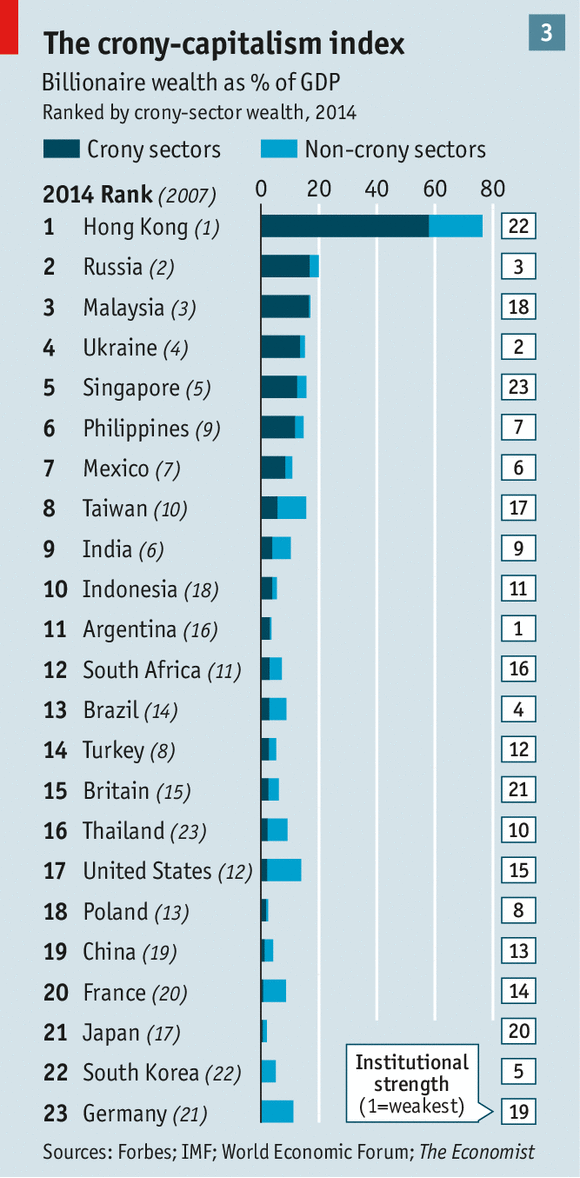
To test the claim that rent-seekers are on the rampage, we have created a crony-capitalist index. Our approach builds on work by Ruchir Sharma of Morgan Stanley Investment Management, Aditi Gandhi and Michael Walton of New Delhi's Centre for Policy Research, and others. We use data fromForbes to calculate the total wealth of those of the world's billionaires who are active mainly in rent-heavy industries, and compare that total to world GDP to get a sense of its scale. We show results for 23 countries—the five largest developed ones, the ten largest developing ones for which reliable data are available, and a selection of eight smaller ones where cronyism is thought to be a big problem. The higher the ratio, the more likely the economy suffers from a severe case of crony-capitalism.

We have included industries that are vulnerable to monopoly, or that involve licensing or heavy state involvement (see table 1). These are more prone to graft, according to the bribery rankings produced by Transparency International, an anti-corruption watchdog. Some are obvious. Banks benefit from an implicit state guarantee that lowers their cost of borrowing. When publicly owned coal mines, land and telecoms spectrum are handed to tycoons on favourable terms, the public suffers. But the boundary between legality and graft is complex. A billionaire in a rent-heavy industry need not be corrupt or have broken the law. Industries that are close to the state are still essential, and can be healthy and transparent.

A galaxy of riches

Billionaires in crony sectors have had a great century so far (see chart 2). In the emerging world their wealth doubled relative to the size of the economy, and is equivalent to over 4% of GDP, compared with 2% in 2000. Developing countries contribute 42% of world output, but 65% of crony wealth. Urbanisation and a long economic boom have boosted land and property values. A China-driven commodity boom enriched natural-resource owners from Brazil to Indonesia. Some privatisations took place on dubious terms.

Of the world's big economies, Russia scores worst (see chart 3). The transition from communism saw political insiders grab natural resources in the 1990s, and its oligarchs became richer still as commodity prices soared. Unstable Ukraine looks similar. Mexico scores badly mainly because of Carlos Slim, who controls its biggest firms in both fixed-line and mobile telephony. French and German billionaires, by contrast, rely rather little on the state, making their money largely from retail and luxury brands.

America scores well, too. The total wealth of its billionaires is high relative to GDP, but was mostly created in open sectors. Silicon Valley's wizards are far richer than America's energy billionaires. It is one of the few countries where rent-seeking fortunes grew only in line with the economy in recent years, which explains its improved position since 2007. Despite concerns about vampire-squid financiers, few of its billionaires made their money in banking. Even including private equity as rent-seeking, on the grounds that it benefits from tax breaks and cheap loans, would make little difference. Compared with Larry Ellison of Oracle, Stephen Schwarzman of Blackstone is a pauper.

Countries that do well on the crony index generally have better bureaucracies and institutions, as judged by the World Economic Forum. But efficient government is no guarantee of a good score: Hong Kong and Singapore are packed with billionaires in crony industries. This reflects scarce land, which boosts property values, and their role as entrepots for shiftier neighbours. Hong Kong has also long been lax on antitrust: it only passed an economy-wide competition law two years ago.

Another surprise is that despite its reputation for graft, mainland China scores quite well. One reason is that the state owns most natural resources and banks; these are a big source of crony wealth in other emerging economies. Another is that China's open industries have fostered a new generation of fabulously rich entrepreneurs, including Jack Ma of Alibaba, an e-commerce firm, and Liang Wengen of Sany, which makes diggers and cranes.

One of the most improved countries is India, which moved from sixth place in our ranking to ninth. Recent graft scandals and a slowing economy have hurt many of its financially leveraged and politically connected businessmen, while those active in technology, pharmaceuticals and consumer goods have prospered. Turkish billionaires in rent-seeking industries have been hit by their country's financial turmoil. By contrast most countries in South-East Asia, including Indonesia, Thailand and the Philippines, saw their scores get worse between 2007 and 2014, as tycoons active in real estate and natural resources got richer.

Who are you calling a crony?

Our crony index has three big shortcomings. One is that not all cronies make their wealth public. This may be a particular problem in China, where recent exposés suggest that many powerful politicians have disguised their fortunes by persuading friends and family to hold wealth on their behalf. Unreliable property records also help to disguise who owns what.

Second, our categorisation of sectors is crude. Rent-seeking may take place in those we have labelled open, and some countries have competitive markets we label crony. Some think America's big internet firms are de-facto monopolies that abuse their positions. South Korea's chaebol, which sell cars and electronics to the world, are mainly in industries we classify as open. But they have a history of bribing politicians at home. China's billionaires, in whatever industry, are often chummy with politicians and get subsidised credit from state banks. According to Rupert Hoogewerf of the Hurun Report, a research firm, a third are members of the Communist Party. Sectors that are cronyish in developing countries may be competitive in rich ones: building skyscrapers in Mumbai is hard without paying bribes, and easy in Berlin. Our index does not differentiate.

The third limitation is that we only count the wealth of billionaires. Plenty of rent-seeking may enrich the very wealthy who fall short of that cut-off. America's subprime boom saw hordes of bankers earn cumulative bonuses in the millions of dollars, not billions. Crooked Chinese officials may have Range Rovers and secret boltholes in Singapore—but not enough wealth to join a list of billionaires. So our index is only a rough guide to the concentration of wealth in opaque industries compared with more competitive ones.

Despite the boom in crony wealth, there are grounds for optimism. Some countries are tightening antitrust rules. Mexico has many lucrative near-monopolies, from telecoms to food, but its government is at last aiming to improve regulation and boost competition. India's legal system is trying to jail a minister accused of handing telecoms licences to his chums.

Encouragingly, there are also hints that cronyism may have peaked. The share of billionaire wealth from rent-seeking industries has declined in developing countries, from a high of 76% in 2008 to 58% (see chart 4). That partly reflects lower commodity prices. But now that emerging markets are slowing, investors are becoming pickier. More are steering clear of firms in opaque industries with bad governance. The price-earnings ratio of firms in crony sectors is now at its biggest discount to firms in open sectors for 15 years. That suggests that the highest returns to outside investors are to be found in open industries.

Perhaps when growth picks up again in emerging markets, rent-seeking will explode once more. Or, as countries get richer, the share of great wealth that is made in crony industries may naturally decline. In 1900 American tycoons became rich by building and financing railroads. By 1930 the action had shifted to food production, photography and retailing. Cronies around the world should take note.

Mishaps Mar Malaysia’s Handling of Flight Tragedy

Posted: 17 Mar 2014 02:22 AM PDT

Asia Sentinel

Miscues and media gaffes are turning Malaysia into an object of anger and criticism in the aftermath of the disappearance early Saturday morning of a Malaysian Airlines jetliner carrying 239 passengers and crew.

No trace of the craft has been found despite a search encompassing thousands of square kilometers.  On Wednesday, the day was dominated by confusion over reports that the aircraft might have attempted to head back toward Malaysia before it disappeared.

Malaysia's air force chief told reporters very early Wednesday that the plane had veered off course. Later in the morning, the same officer denied the report sharply. By Wednesday afternoon, the government seemed to reverse itself again, requesting assistance from India in searching the Andaman Sea, north of the Malacca Strait, where the plane may have gone down far from the current search area off the coast of Vietnam.

Officials finally said the plane “may” have been heading toward the Strait of Malacca when it disappeared and that the search was now also concentrated in that area.

Other countries have grown frustrated.  The Chinese, with 152 passengers on board, have complained about a lack of transparency over details. They have also complained that Malaysian Airlines staff handling relatives of the victims in Beijing have been short of information and in many cases don't speak Mandarin.

From the start, according to critics, the Malaysians have treated the disappearance and ensuing inconsistencies as a local problem instead of one that has focused the attention of the entire world's media on the tragedy. In a semi-democratic country with a largely supine domestic media, the government insists it has the situation in hand but that hardly seems the case.

Often, those giving press briefings about the affair communicate badly in English to an international press whose lingua franca is English.  Because of widely differing reports of where the aircraft actually disappeared, the picture being delivered is one of incompetence. Networks like the BBC and CNN are openly declaring that the post-accident situation is a mess.

Some of it isn't Malaysia's fault.  An initial report that two possible hijackers using fake passports somehow got through the country's passport control because of lax surveillance turned out to be false.  While the two were traveling on false passports, apparently the stolen documents had never been reported to Interpol, which tracks such incidents.  The pair turned out to be Iranians seeking asylum in Europe.

But that wasn't helped by the fact that Malaysian authorities originally said erroneously that as many as four to five people could have been traveling with suspect passports, raising the possibility of a fully-fledged hijack gang aboard.

But five days into the loss of the aircraft and with no idea of where it could have disappeared, there is growing concern over who is in charge, coupled with the fact that Prime Minister Najib Tun Razak has largely removed himself from the picture, allowing his cousin, Hishammuddin Hussein, the defense minister and acting transport minister, to deal with the affair.

International treaties that allow for Malaysia to greatly expand the probe by calling in experts from foreign governments to help were not invoked until Wednesday, it seems, when it was reported that US and other foreign experts had finally been invited to take part in the formal investigation. It seemed again that valuable time had been lost.

Much of the problem is due to the fact that the Malaysian government has habitually handled information as a problem rather than as a means of communication. The mainstream news media are all owned by the ruling political parties and are used to being fed information the government wants them to hear.  Government-owned MAS at one point issued a press release only to recall it twice because of misspellings and misinformation.

In a deeply divided political culture, especially in the last year as the opposition has grown more effective, the government is finding it difficult to manage the flow of information on a disaster. In addition, in the midst of this flight crisis the government is seeming preoccupied by court actions to drive two opposition leaders, Anwar Ibrahim of  Parti Keadilan Rakyat, and Karpal Singh of the Democratic Action Party, out of Parliament.

At the start, the plane was characterized as having simply gone off the radar – until Wednesday, when a report carried in Berita Harian, a government-controlled Malay-language newspaper, quoted Air Force chief Gen. Rodzali Daud as saying Malaysian radar had tracked the missing Boeing 777-200 turning left from its last known location on radar. It then supposedly crossed Malaysia itself and disappeared over the Strait of Malacca.

The report set off a frenzy. CNN and the BBC carried maps of the new possible crash site as it was reported that the massive search for the wreckage had shifted to the waters between Malaysia and Indonesia instead of the South China Sea off the coast of Vietnam.

Then the report was emphatically denied by Daud, who told a press conference that “I wish to state that I did not make any such statements as above."

CNN, however,  quoted an unnamed "senior air force source" as saying the plane indeed had shown up on radar for more than an hour after contact was lost at around 1:30 a.m. Saturday. The craft was last detected, according to the official, near Pulau Perak, a small island in the Strait of Malacca.

Has four days been wasted by a huge flotilla of airplanes and ships that have been scouring the South China Sea for wreckage while the plane might actually be somewhere 900 km. to the west?  The Vietnamese announced they were suspending their participation in the search.

Chinese Foreign Ministry spokesman Qin Gang on Tuesday complained about the lack of progress in finding the plane, saying "We once again request and urge the Malaysia side to enhance and strengthen rescue and searching efforts."  The Chinese government itself is starting to feel the heat, offering to deploy 10 satellites in the effort to find the plane.

The crisis wasn't helped any by a sensational revelation from Australia by a young South African woman that she and a friend had once ridden in the cockpit of an MAS flight from Phuket to Kuala Lumpur at the invitation of the missing co-pilot, Fariq Abdul Hamid, and had pictures of themselves flirting with the pilots, who were even smoking in the cockpit, to prove it.

Since 9/11 in the United States, airline regulations forbid anyone not part of the crew from gaining access to the cockpit. If nothing else, the story and the pictures are an indication of lax flight deck discipline and raise questions if someone could have got into the pilots' cabin aboard MH370.

Wan Azizah: Is everything Anwar’s fault?

Posted: 17 Mar 2014 02:13 AM PDT

Malaysiakini

In questioning a news report which linked the pilot of MH370 to her husband, PKR president Dr Wan Azizah Wan Ismail asked: “Is everything Anwar’s fault?”.

She was responding to UK tabloid Daily Mail‘s report that Captain Zaharie Ahmad Shah, a PKR member, is a “political fanatic”.

“There are many PKR members. They say Captain Zaharie cried over the (sodomy) verdict. Millions of other Malaysians did so, too," Wan Azizah said.

Daily Mail had reported that Zaharie (right) was in court when the verdict with regard to Anwar Ibrahim's conviction was delivered less than 24 hours before MH370 took off from KLIA at 12.41am on March 8.

Berita Harian also published a column floating the theory that the mysterious disappearance had to do with claims that most MAS pilots support Pakatan Rakyat.

Wan Azizah also denied that Pakatan is politicising the disappearance of MH370 but was merely criticising what seemed to be poor crisis management on the part of the government.

“We sympathise with the victims but we criticise how the government has handled this crisis. We are not politicising it.
“We see a lack of preparedness for such crises, especially aviation ones. We prepare for floods and crises on land but not in the air. That is the critique,” the Kajang by-election candidate told reporters.

BN leaders had urged Pakatan to stop politicising the missing Malaysia Airlines’ aircraft on the campaign trail.

Meanwhile, PKR Kajang by-election director Abdul Khalid Ibrahim said the party does not dispute that Zaharie is a PKR lifetime member.

“It means he paid the party RM200. Just like I did,” he added.